Showing posts with label Science Fiction. Show all posts

Monday, 10 November 2008

Flux and Hard Fiction


Flux, by Stephen Baxter was a reasonably good read.

Although the initial pages seemed to me to set up a trajectory for the book that it did not really end up going in, it was still a reasonably interesting story.

What I found interesting, on reflection, was the illustration of a previous post of mine that there really is no such thing as hard Science Fiction. Or, to put it another way.

All hard Science Fiction is soft somewhere.

Baxter does a very good job of building a world inside a sun. He works very hard at making plausible explanations of how a living being might operate in that environment. There are a few dissonances that are resolved in a satisfying way. For example references to the metric units are quite clever. And, although I have not the knowledge to know whether the atomic effects he describes are valid or not, and suspect there would be unmentioned factors that make his creation unstable, nonetheless his world building is convincing. That's all it takes.

A good plot, interesting characters and a convincing world is all it takes.

However, trying not to give too much away, at the end of the book Baxter does resort to the Deux ex Machina. He does it well, and we have the hints and introductions earlier in the book so that it is not surprising and not discordant. But the last couple of chapters do resort to Wizard of Oz science fiction. The descriptions of mechanics and theory are abandoned and the science is minimised in favour of plot. How does this character's manipulations influence the world? How does the great big machine work?

We are not told, because, basically, at this point the vision of the science fiction writer is beyond the science to describe.

I think that's true of all science fiction. The fiction always leaves the science behind. And rightly so. The science is the servant of the fiction.

A good read, with some novel ideas.

Seven Suns out of Ten

Tuesday, 24 June 2008

Agreeing with Heinlein


I was born too late to appreciate Robert A. Heinlein's work. I get too fussy about things like characterisation and plot.

Coming into Science Fiction when it has matured makes it harder to appreciate the masters who helped make it what it is.

Heinlein illustrates, for me, the contrast between idea driven science fiction on the one hand and character or plot driven fiction on the other. (although a good story does it all together) I find his manipulation of plot and assertions of 'the way it is' somewhere between flippant and arrogant.

Perhaps one could define a master as someone who breaks all the rules of writing (show don't tell etc etc etc) and gets away with it.

I also disagree quite strongly with Heinlein's conclusions about the way the world is. The meaning of life, the universe and everything, if you like.

So it was quite a shock to see within a couple of chapters some arguments and ideas that I particularly agree with. To whit:

In the mouth of Lazarus Long, who at this point in the novel is being portrayed as a sage,

"Never mind computers. Ira, the most sophisticated machine the human mind can build has in it the limitations of the human mind. Anyone who thinks otherwise does not understand the Second Law of Thermodynamics." Time Enough For Love p29 1982 reprint.

This relates to one of the philosophical problems that people who are strict evolutionists have. How do you inject meaning and purpose, any sense of value into a world defined (by the evolutionary assumptions to have none) The common answer is that we create value, but Heinlein's argument applies equally to this question. It is impossible for the product to be greater than the system that created it. If human life is the result of meaningless happenstance, it can have no meaning.

Also:

"To figure out the basic questions about this world it would be necessary to stand outside and look at it. Not inside. no not in two thousand years, not in twenty thousand." Time Enough For Love p39 1982 reprint.

This statement seems almost anti-enlightenment in its assertion of the limit to human understanding. While Heinlein was probably not thinking along these lines (and would perhaps be horrified by my use of his words) this statement agrees with my understanding of the inability of the fallen human creature to fully understand himself without input from the creator. This idea stands in stark contrast to the enlightenment and modern ideas of the progress of human knowledge (and in particular scientific inquiry). It is also quite different to the postmodern rejection of authority and meta narrative which actually makes an absolute authority out of personal subjective understanding.

I read Heinlein because I like Science Fiction, because I respect his lofty position amidst the great authors, and because I like to understand the ideas that I disagree with.

So it's felicitous to find something in his work that I can actually agree with, even if I would come to a different conclusion at the end.

Friday, 13 June 2008

Do Your Research

I just finished Reckless Sleep by Roger Levy.

Apart from a few scenes and expletives I skipped it wasn't a bad book. There were a couple of niggling questions unanswered and the end had a little bit of the Deux Ex Machina about it, but this was outweighed by the well wrought scenery and technology, and by the realistic reactions and portrayals of the characters. The end-of-world-by-environmental-destruction setting wasn't too overplayed and there was a reasonably convincing explanation.

But here's my big beef at one little point. This is not a big problem in the novel, but only a big problem for me from my perspective. The reason given for the earthquake and volcanic Armageddon is that a bunch of fundamentalist Christians planted nuclear bombs in the earth's crust and set of a bunch of chain reactions.

OK, here's the thing. There is no way Christian fundamentalists would do that kind of thing. I write as a Christian, of some 20 years experience in Christian circles and with some knowledge of the Bible, I can see no way this could happen.

I'm not going to try to convince you that fundamentalists are not the hateful bigots they are portrayed as. The very few who are hateful get too much publicity and the way they are censured by godly Christians is never publicised (eg Fred Phelps gets more criticism from Christians than from the secular) Also, it's very difficult for someone on the one side of a debate as emotional and entrenched as the Western culture wars to see consistency or credibility and on the other side. So that's not my point.

What I want to suggest is that the end of the world, Armageddon, the return of Christ, these things are all emphatically in God's hands in the Bible and consequently within the Christian faith. Belief in God is often given as the reason why some bunch of Christian wackos try to end the world. But it is that very belief in God that would make it impossible for them to consider such a thing. Do your research. Christians believe the end of the world is in God's hands. When they see the suffering and evil in this world they may want it to come soon, seeing it as the only solution to the groaning world. But they would never try to force God's hand.

If you were going to portray Japanese culture, or Zoroastrian ritual in a novel you would try to get it right. So why do people feel that when it comes to portraying Christians you don't have to do any research? You don't have to actually understand them? You can just scapegoat them?
Feel free to criticise Christians, lampoon our foibles, ridicule the pompous, discredit the bad arguments and expose the hypocrisy or immorality, but please, get it right.

Friday, 9 May 2008

Why Is It So?


Science Fiction author China Mieville raises an idea that I have been thinking about for some time. What is it that science does? People tend to think that science answers why questions. Why do apples fall to the ground? Why do some people get sick? While science investigated these questions, I don't think it answers them.

I think science provides descriptions not explanations. This is how Mieville puts it:

"lsaac was still piqued by the ignorance surrounding watercraeft. It brought home to him, again, how much mainstream science was bunk, how much 'analysis' was just description - often bad description - hiding behind obfuscatory rubbish."
Perdido Street Station, 2000, p28

I hope we can excuse the derogatory tone (this is put into the mind of a fairly brusque scientist, so maybe we'll forgive the harshness). But it's an interesting point.

I remember the time I snuck a look at my X-ray report from the radiologist and discovered the word idiopathic, which is a word that means in layman's terms 'it's just there'. There is a word invented to put on the reports that says 'I don't really know'. I was terribly disappointed to discover that little Band-Aid of a word almost completely covers up a vast ignorance of my condition.

Before I go on, let's not underestimate the power of description. Science is a powerful tool. It is acute and accurate description that helps us understand the processes of most of the systems of our world and allows us to influence and change many of them. From scarlet fever to semiconductors science has brought great benefit.

But as I said before I don't think it answers the why questions. We ask the 'why' question, but we end up with a 'how' answer. And I think many people don't realise that, perhaps even many scientists.
An example: We ask the question, "Why does the apple fall to the ground?" And we answer, "Easy, gravity. But gravity is just a name for what happens, not an explanation of why it happens. Newton didn't discover gravity he named it. Before Newton coined the word things were falling to the ground and his label didn't make any difference.

Furthermore, Newton's equations, although powerful, and revolutionary, still do not explain why. Newton's equations with great mathematical beauty describe the manner in which bodies attract each other. And, once again, let us not forget how powerful theses equations are. These beautifully simple equations explain the complex dance of the planets in the sky. To extrapolate the falling of objects in our atmosphere to the level of the moon and planets was an astounding leap of understanding, and provided the needed foundation for the mechanics of a heliocentric universe.

But Newton still hadn't answered why. And even today, we still haven't answered why objects with mass are attracted to each other. Why is it so? We just don’t know. And diagrams and theories and descriptions of bodies of mass bending space don't take us any closer to an answer. For every question science answers, we get another question. Along the way we get a better understanding of the process, but we never seem to get closer to purpose or reason.

Let me give you a recent example of what I am talking about. This article in the Sydney Morning Herald. http://news.smh.com.au/secrets-of-the-platypus-revealed/20080508-2c2x.html

THE platypus is a bizarre creature: a furry mammal that lays eggs, makes milk like a cow, produces venom like a snake, has a bill like a duck, and detects its prey using electricity.

Now scientists have discovered why.

Scientists have discovered why…

The article goes on to talk of the recent coding of the platypus genome. And the reason that the platypus is the weird creature it is is…

Jenny Graves, of the Australian National University, said the platypus had genetic features similar to those of other mammals, birds and reptiles, as well as unique ones. "We expected the genome to be weird, and it certainly is," she said.

Can you see what I mean? This is a description, not an explanation.
I have no more than a layman's understanding of DNA, but I would have expected the platypus to have both similar and different DNA to humans. This explanation does not answer why platypuses are as they are. It gives us more detail, a better understanding of what a platypus is, but no better understanding of why.

Sunday, 27 April 2008

Soft Sci-Fi


All science fiction is fantasy.

I'm not suggesting there aren't two distinct genres. I'm not referring to ambidextrous authors who write well in both genres. I don't like it when second-hand bookshops to lump it all together under the umbrella heading 'Sci-Fi/Fantasy'.

I guess what I am saying is that there is really no such thing as hard science fiction.

Hard science fiction is the term used to describe science fiction that pays attention to scientific detail. Science fiction that cares about scientific plausibility. I've sometimes heard the term used in almost an elitist sense, hard sci-fi is capital 'S' Science fiction. As if space opera or cyberpunk, etc. were lower life forms.

But when it comes down to it science fiction isn't just science it's science fiction. As fiction it moves beyond the boundaries of science. Science fiction is about taking the world as we know it and extrapolating into a alternative reality or a possible future. Except that in all science fiction that created world, that extrapolated future is actually not scientifically possible.

At our present level of understanding wormholes are not controllable. Time travel is impossible. Intersolar trade is completely uneconomical, interstellar war unpractical. Human consciousness cannot be understood, let alone digitalised. And there is no reliable evidence for extraterrestrial life. All of these elements of science fiction are fantasy.

The difference between science fiction and fantasy is not scientific credibility. It is a matter of themes and customs. Fantasy has common themes like magic, mythical races and creatures. Science fiction has different themes, technology and extra terrestrial races and creatures. Each genre intersects our mundane world at a different point. Fantasy leaves our world in dark forests or in the mists of time and legend. Science fiction launches into a different reality from the launch pads of a space port.

But both leave the reality of our mundane world.

What distinguishes science fiction from fantasy is the additional requisite that science fiction must seem scientifically plausible. Good fantasy must have a created world that is consistent and believable. A magic system must be logical and workable. In Science Fiction the world must also be consistent and believable but science fiction must also seem scientifically plausible. But this scientific plausibility is an illusion. At some point every science fiction writer fudges the science. Deliberately blurs the detail or skates over the limit of our current knowledge or overemphasises the strength of that force or the extent of our mastery of that technology.

They do that because we let them, we want them to.The reader and the writer have an agreement. If you have a good crack at it, if you make it half way believable, I'll suspend my disbelief. I'll come along for the ride.

We make that agreement because it allows us to explore human nature. To mentally explore the universe while we can't yet physically do so. It allows us to discuss the ramifications of science and it's effects on our societies. But perhaps mostly, we write and read science fiction because it's fun.

But when it comes down to it, science fiction is a fantasy, a fiction. A useful fiction, an enjoyable fiction, but a fiction nonetheless.

Friday, 7 December 2007

Isn't he that french guy?

What's with the funny name for the blog??

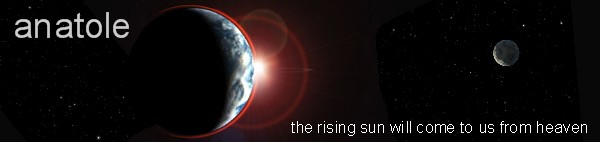
anatole brings together some key facets of who I am. Not that I have a penchant for obscure french names (or anglicised french words either). anatole menas something like 'rising dawn' in Greek. I looked it up. It conjures, for me, an image of a distant sun dawning behind a planet shrouded in it's own shadow. Rays reach forward from beyond the edge of the planet promising the new dawn of light on all bound by gravity below. You can see the cover of a mass market science fiction paperback, can't you? Although I suspect that viewing sun and planet from space rules out atmospheric imperfections which renders rays from the sun invisible. Nonetheless, I guess it's obvious that I enjoy reading and thinking about science fiction. So I like the image of anatole.

anatole, the Greek word that the french name comes from, is also a word used in Luke's Gospel to describe Jesus Christ. The rising dawn bringing light and hope to the world. That's a deeper reality of who I am. Someone who seeks to live in the light of Christ and looks forward to the spread of that light that brings peace to all who live under it's grace. And for a long time I've thought about writing about science fiction from my Christian perspective. And well, now's a good time to start. So among other things, that's what I intend to do here. Let me know what you think.

God Bless You.