Showing posts with label atheism. Show all posts

Thursday, 27 October 2011

Vanishing Foundations

One of the things mathematics taught me is that you have to start somewhere.  Some things you just have to accept.  Axioms are assumed to be true (usually because they are self evident) but are unprovable.

One thing discussions with atheists have taught me is that everyone (no one is excepted, here) finds it easier to see someone else's assumptions while often remaining ignorant of their own.

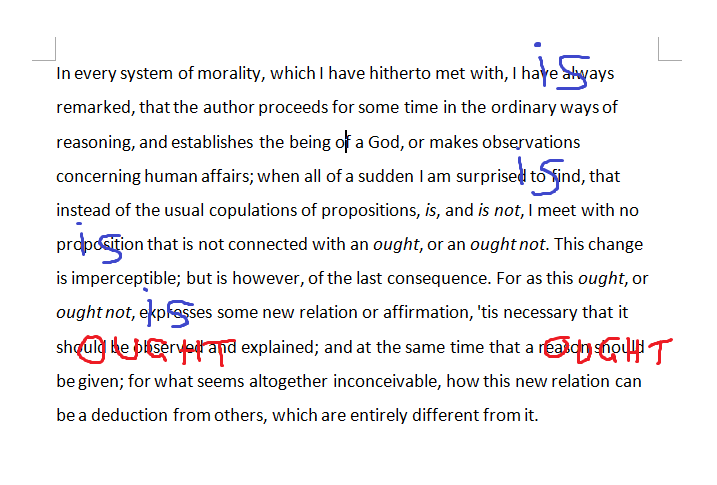
Let's have some fun seeing what that looks like.  David Hume raised the is/ought problem, also known as Hume's law or Hume's gillotuine.  When used in an argument, Hume's law might be deployed something like, "You can't get an ought from an is."

"School education is a shambles, we ought to put more money into schools."
This doesn't necessarily follow, for example
"School education is a shambles, we ought to stop wasting money on a broken system."

Which contention is correct needs to be established by further argument.

That's a simplified application.

But here's a really interesting application of Hume's law to Hume's law.

This is Hume's Law as he originally expressed it:

Tuesday, 3 February 2009

People Believe What They Want


I've often heard the rubric,
"People believe what they want to believe"


I've most often heard it directed in derision against Christians. Which I find funny. If I was making my own religion, it wouldn't have looked much like Christianity.

The problem with that saying is, of course, that everyone loves to apply it to everyone else, but not to themselves.

I think the practical way of putting it would be something like,

"Be suspicious of anyone who tells you what you want to hear."

Let me show you what I mean. When the preacher man says, "God loves America" I would like the patriotic Christians of America to just ask, "Where does it say that?" and "What does it mean by that?" and to just ask, once, "How has America also displeased God?"

When the Mullah in the middle east says that killing Americans gets you to heaven, I think it's a little suspect.

And into this category I would also put the Atheist bus ads in London. The ads essentially carry the philosophical load of the old phrase, "Eat drink and be merry." (We've stopped saying the ending because it's not done to face the reality of death these days) That's what we want to hear, so wouldn't you expect the atheists to be a little more skeptical.

As to pointing the finger back at myself. As a Christian, there are times when I probably need to be challenged. I'm human. But overall I think the Christian message has stuff I really don't want to hear.

You're a sinner - who wants to be told that?
God will judge the world - is that a cheery thought?
Love your enemies - nobody likes to actually practice this.
Submit your will to God - not going to attract a lot of people.

No, I believe the unpalatable truths of the Christian faith because I lost the battle to disprove them, because I am convinced of their truth, not because I liked them.

For a discussion of those atheist ads from a person smarter than I you could look here and here.
Monday, 17 November 2008

Northern Flights (of Fancy)


I found Philip Pullman's Northern Lights (filmed as The Golden Compass) in the Op Shop so I bought it. I'd heard a bit about how terrible he was so I thought I'd look-see for myself.


It's a strange book for an atheist to write.


In the first chapter there was a reference to Pope John Calvin. A not so subtle dig at Christians, although it either showed a huge ignorance or a just as huge indifference. That Calvin could be a pope or that Calvin would be the kind of pope portrayed is laughable. That every person has a daemon companion (pronounced demon according to the note at the start) is perhaps a dig at Christians also. At any rate it should make most Christians uncomfortable, and this use of the word daemons alone is enough for me not to recommend the book.


So after a slow start the book gets interesting. Maybe shopping with Mrs Coulter would amuse my daughters, but we'll never know. For me the tension was a bit dull, waiting for some tension to develop. When it does, however, he does a fine job of it. Lyra's adventures are fun and though an unusual protagonist she does become an endearing one.


But this is the funny thing. For a book that has been touted to be so anti-Christian and deliberately too, it seems to not be really trying. The church is everywhere in the background, but none of the villains are church people directly. The church is just the political backdrop against which they work. In fact, the protagonist's anti-church hero ends up being more evil than the bad guys operating under official church sanction. Either Pullman is being very subtle and lulling us before he pulls out some big guns in later books or he is missing the mark.


It's also a funny book for an atheist to write because it is full of spiritual stuff. I am cynical about new pagans who write modern fantasies with their made up worlds and creatures attacking the church - which is historical. It is laughable for an atheist in his supposed attack on Christianity to make up talking bears, quasi-spiritual beings called daemons, witches who ride tree branches, other worlds seen in the aurora. He's batting for the wrong side here. You can't argue for the nonexistence of a spiritual being with other spiritual beings and phenomena. You've opened the door.


If his intent is to discredit the church or faith, he also misses the mark because in order to make his official church doctrines look foolish he has to change the Bible to fit his world. The Bible he sets up for critique and the church he subtly discredits is not the real Bible and not the real church. In fact the church as portrays it does not resemble the church at all.


Conclusion
Unless he is able to convince someone who doesn't know better that that is what the church is really like, his book is not a powerful atheist work. Whether the sharp knives come out in later books we will wait and see. Would I encourage my kids to read it? No. Would I call the marines if they did stumble across it in the library or read it in class? No. I'd just want to talk about it.

Post Script
What I found really ironic was that in the book I found one of the most apt and most sensible approaches to the whole predestination/freewill debate in the conversation between the witch and the aeronaut. Although she uses the word fate, I believe the sentiment is correct when we think about God's sovereignty and our self determination. She says, "We are all subject to the fates. But we must all act as if we are not," I believe this summarises our Christian understanding of sovereignty and human responsibility. If God is in control, why should I do anything? "We are all subject to God's sovereignty. But we must all act as if we are not."
But the big question, "What is an atheist doing talking about Fate anyway?"


Seven White bears out of Ten but not recommended.